AI Visibility — SEO & GEO2026-10-09T10:19:03+00:00
SEO & GEO CONSULTING

SEO & GEO consulting:
found in Google, cited by AI.

SEO & GEO consulting:
found in Google, cited by AI.

When buyers ask ChatGPT, Perplexity or Gemini for a recommendation, only a few companies are named. Our SEO & GEO consulting is built to put you on that short list.

MORE VISIBILITY
STRONGER BRANDS
SUSTAINABLE GROWTH
MORE VISIBILITY
STRONGER BRANDS
SUSTAINABLE GROWTH
AS FEATURED IN

Featured in more than 450 news sites and business publications

Featured in more than 450 news sites and business publications

ABC
The Leader
SI
Morning News
NBC
Fox News
USA News
International Business Times
CBS
AP
OUR METHOD

We measure before we change anything

We measure before we change anything

Syntharis Group combines classic search engine optimization with Generative Engine Optimization, measures how AI systems describe your business today and improves the content and evidence they rely on. The method is the one our CEO, PhDr. Oliver Scharfenberg, describes in his book The AI Visibility SEO & GEO Playbook

SEARCH HAS CHANGED

A good ranking is no longer enough

A good ranking is no longer enough

People now ask complete questions and receive a finished answer. By early 2026, roughly 68% of US Google searches ended without a click to any website (SparkToro and Similarweb). A Pew Research Center analysis found that users clicked a traditional search result in 8% of visits when a Google AI summary appeared, compared with 15% without one. As The AI Visibility SEO & GEO Playbook puts it, a second contest now sits on top of the old one: not only “do I rank?” but “am I in the answer?”.

That does not make SEO obsolete. Google’s AI features are built on its search index, so good SEO remains the entry ticket. But it has to be complemented by work on the sources and signals AI systems use when they decide whom to name.

TWO LAYERS, ONE STRATEGY

What SEO does and what GEO adds

What SEO does and what GEO adds

Syntharis Group combines classic search engine optimization with Generative Engine Optimization, measures how AI systems describe your business today and improves the content and evidence they rely on. The method is the one our CEO, PhDr. Oliver Scharfenberg, describes in his book The AI Visibility SEO & GEO Playbook

OUR METHOD

The frameworks behind our work

Our GEO work follows the models PhDr. Oliver Scharfenberg developed in The AI Visibility SEO & GEO Playbook. They make a young discipline manageable.

WHAT WE DO

Our SEO and GEO services

Our SEO and GEO services

DELIVERABLES

What you receive from us

What you receive from us

OUR APPROACH

How a GEO project works

The phases follow the 90-day GEO roadmap from The AI Visibility SEO & GEO Playbook.

WHO IT IS FOR

When SEO & GEO consulting pays off

When SEO & GEO consulting pays off

  • Your buyers ask ChatGPT, Perplexity or Gemini for recommendations and your competitors are named

  • AI tools describe your company wrongly, outdated or not at all

  • You rank in Google, but traffic falls because AI Overviews answer the question

  • You offer B2B services, study programs or jobs that people research carefully before they decide

What no one can promise

No provider controls which companies Google or an AI system shows. Anyone who guarantees a position in ChatGPT is overpromising. What we can do is build the signals that make citations far more likely, and show you transparently what changes.

WHY SYNTHARIS

What makes our approach different

What makes our approach different
  • A published method: the frameworks come from The AI Visibility SEO & GEO Playbook by our CEO

  • A baseline first: we record how AI systems answer today, so progress can be proven later

  • SEO and GEO together, so you do not pay two agencies for overlapping work

  • Fewer, better pages, each backed by data and named sources

  • Research experience: our CEO designs and publishes studies, which is how citable evidence is built

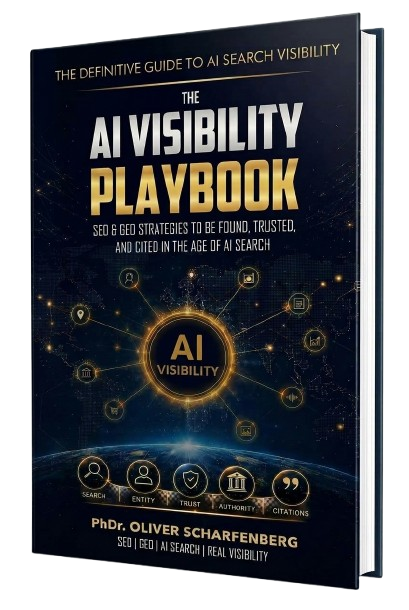
3D-rendered book cover titled 'The AI Visibility Playbook' with a glowing AI visibility graphic and network icons, dark blue background, subtitle and author name faint at the bottom.
FROM OUR CEO

Read the method first: The AI Visibility SEO & GEO Playbook

Read the method first: The AI Visibility SEO & GEO Playbook

Written by PhDr. Oliver Scharfenberg, CEO of Syntharis Group, the book is a practical manual for being found, trusted and cited now that AI tools answer so many searches. It separates high-confidence advice from emerging guidance, includes ten case studies from local businesses to higher education, templates for a GEO audit and prompt monitoring, and 50 prompts to track how AI systems describe your brand.

“Visibility creates opportunities.”

PhDr. Oliver Scharfenberg Founder, Syntharis Group

ABOUT THIS PAGE

Based on Doctoral Research

Based on Doctoral Research

This page was written by PhDr. Oliver Scharfenberg, Founder & CEO of Syntharis Group and author of The AI Visibility SEO & GEO Playbook. He has advised more than 750 companies on marketing and employer branding.

Last reviewed: 30 September 2026.

FAQ

Frequently Asked Questions

Frequently Asked Questions

Do I need to optimize my website in several languages for AI search?2026-10-08T18:57:27+00:00

If your customers search in different languages, yes. AI systems answer in the language of the question and often draw on sources in that language, so a question asked in German, Spanish or Japanese can produce a different set of recommended companies than the same question in English.
For international B2B companies we recommend starting with the priority markets and the pages that matter most for revenue, using native-language content rather than literal translation, and making sure company facts are identical in every language version. In some Asian markets, local search engines and platforms such as Baidu in China or Naver in South Korea also have to be considered.

What is AI visibility, and why does it matter in 2026?2026-10-08T19:03:41+00:00

AI visibility is how often, and how accurately, your brand is surfaced, described and cited when people get answers from AI systems like ChatGPT, Perplexity, Google’s AI Overviews, Gemini and Bing Copilot. It is the AI-era counterpart to ranking on Google: instead of competing for a click, you compete to be one of the few sources an AI names in its answer.

It matters because search is increasingly answered without a visit to any website. A behavioral study by the Pew Research Center of nearly 69,000 real Google searches found that when an AI Overview appears, users click a traditional result only about 8% of the time, compared with 15% when there is no AI summary. By early 2026, roughly 68% of US Google searches ended without a click to any website, according to SparkToro and Similarweb. Being inside the answer still pays: Seer Interactive found that brands cited within AI Overviews earn about 35% more organic clicks than comparable brands that are not cited on the same results page.

What is the difference between SEO and GEO?2026-10-08T19:03:56+00:00

SEO (Search Engine Optimization) gets your pages to rank in traditional search results; GEO (Generative Engine Optimization) gets your brand cited inside AI-generated answers. SEO optimizes for rankings and clicks on Google and Bing, while GEO optimizes for inclusion and citation in answers produced by ChatGPT, Perplexity, Gemini, Claude and Google’s AI Overviews.

The term Generative Engine Optimization was introduced by Aggarwal and colleagues in a 2024 study published at the ACM SIGKDD conference. The two disciplines share one foundation (clear, trustworthy and well-structured content) but target different surfaces and are measured differently, which is why a modern strategy runs both together. GEO is also called AEO (answer engine optimization); the tactics overlap heavily.

How do you get a business cited by AI tools like ChatGPT and Perplexity?2026-10-08T19:04:40+00:00

You get cited by making your content the clearest, most credible and most quotable source an AI can draw on. The largest academic study on the question, the Princeton GEO paper, tested content changes across roughly 10,000 queries and found a consistent set of levers. The highest-impact moves are:

  • Answer the actual question directly, with the key takeaway in the first sentence so a model can lift it cleanly.
  • Back claims with evidence: concrete statistics, data and citations to credible sources. In the Princeton study, adding statistics and citing reliable sources were among the strongest tactics, with statistics alone lifting a source’s share of the AI answer by around 40%.
  • Keep your brand facts consistent and machine-readable: structured data, a clear about or entity page and identical company details everywhere.
  • Build off-site credibility: reputable mentions, reviews and profiles that corroborate what your own site says.
  • Write clearly. The same research found that improving the fluency and readability of a page produced a significant visibility gain, even with no new information added.
Does SEO still matter now that people use AI search?2026-10-08T19:05:00+00:00

Yes, SEO is still the foundation. AI answer engines draw heavily on the same content and authority signals that power classic search. Google’s AI Overviews and AI Mode are built directly on top of its search index, so strong organic content often decides whether you are even eligible to be pulled into an AI answer.

What has changed is that ranking no longer captures the full value: Ahrefs’ analysis of 300,000 keywords found that the presence of an AI Overview was associated with a roughly 58% lower click-through rate for the top-ranking page as of late 2025. The practical conclusion: keep investing in SEO and add GEO on top, so you are found in search and cited in answers.

How do you measure AI visibility?2026-10-08T19:05:23+00:00

You measure AI visibility by tracking a fixed set of real, buyer-style questions across the major AI systems and recording whether your brand is mentioned, how accurately it is described and which sources are cited. Because AI answers frequently produce no click, the core metric is presence and accuracy rather than traffic alone.

A reliable method is to define the prompts that matter to your buyers, capture a baseline of how ChatGPT, Perplexity, Gemini and Google’s AI Overviews answer them today, improve the underlying content and evidence, and then re-test on a regular schedule to see whether your share of the answer is rising. No one can guarantee placement in an AI answer, but the signals that earn citations can be built and monitored deliberately.

What does a GEO audit from Syntharis Group include?2026-10-08T18:53:53+00:00

A GEO audit shows how AI systems currently describe your business and why. It usually includes:

  • A prompt set of real buyer questions, tested in ChatGPT, Perplexity, Gemini and Google AI Overviews, with a record of who is mentioned and which sources are cited.
  • A technical check of crawlability, indexing, page speed, robots.txt rules for AI crawlers and structured data.
  • An entity review: are your company name, services, location and people described consistently across your website, profiles and directories?
  • A content review of whether your key pages answer questions directly and back claims with evidence.
  • A comparison with the competitors that AI systems currently prefer.

We diagnose along the Citation Failure Pipeline described by our CEO, PhDr. Oliver Scharfenberg, in The AI Visibility SEO & GEO Playbook: access, relevance, evidence, trust, entity, extraction and freshness. Knowing where a page fails prevents rewriting content that was never the problem. The result is a prioritized action plan and a baseline against which later progress is measured.

Which AI platforms do you optimize for?2026-10-03T04:09:46+00:00

We optimize for the platforms your buyers actually use:

  • ChatGPT (including its search function)
  • Google AI Overviews and AI Mode
  • Perplexity
  • Gemini
  • Microsoft Copilot
  • Claude

The relevant platforms differ by market and target group, so we check where your audience asks questions before setting priorities.

Because Google AI Overviews and AI Mode build on the Google index, and Copilot draws heavily on Bing, classic SEO remains part of every GEO project.

How long does it take to appear in AI answers?2026-10-03T04:09:46+00:00

There is no fixed timeline:

  • Within weeks: systems with live web search, such as Perplexity or ChatGPT search, can pick up improved content once it is crawled and indexed.
  • Months: knowledge that is part of a model’s training data changes only when the model is updated.

For planning purposes, most businesses should expect the first measurable changes in their AI mentions after a few months of consistent work, with stronger effects over six to twelve months.

We re-test the same prompt set regularly so you can see the trend.

Which technical factors influence whether AI systems can use my content?2026-10-08T18:59:21+00:00

AI systems can only use content they can reach, read and understand. These technical factors matter most:

  • Crawler access: robots.txt should not block the crawlers of the systems you want to appear in, such as OAI-SearchBot and GPTBot (OpenAI), PerplexityBot or Bingbot.
  • Rendering: key content should be available in the HTML, not only after complex JavaScript runs.
  • Structured data: Organization, Service, Person, Article and FAQPage schema help machines understand who you are and what a page is about.
  • Clean indexing: canonical tags, sitemaps, no duplicate pages and no thin or empty pages.
  • Speed and mobile usability, which remain important for Google.

Technical fixes alone rarely create citations, but technical errors can prevent them entirely. In The AI Visibility SEO & GEO Playbook this is the base of the Visibility Stack: access, crawlability and structure come before entity clarity, evidence, authority and recommendation. If a lower layer is broken, work on the higher layers becomes unstable.

Does FAQ schema still help in 2026?2026-10-08T19:00:58+00:00

Not for Google’s search results: Google stopped showing FAQ rich results altogether in May 2026, after limiting them to government and health websites in 2023.

The FAQPage markup is still valid Schema.org, and according to Google it does no harm. We keep it because it describes a page’s questions and answers in machine-readable form for other search engines and tools that read Schema.org. What matters far more is the visible content: a short, direct answer in the first sentence, followed by evidence and detail.

How much does GEO consulting cost?2026-10-08T19:01:26+00:00

The cost of GEO consulting depends on the number of topics, markets and languages and on how much of the implementation we take over. A one-off GEO audit with an action plan is the smallest package. Ongoing programs that include content creation, digital PR and monthly AI-answer monitoring cost more.

After a free consultation, you receive a fixed proposal with defined deliverables. Be cautious with offers that promise guaranteed positions in ChatGPT or Google, because no provider controls those systems.

Can you correct wrong information about my company in ChatGPT or other AI tools?2026-10-08T19:02:04+00:00

Often, yes, although not by editing the AI directly. Wrong answers usually come from outdated or contradictory sources: an old address in a directory, an outdated press article, a competitor’s comparison page or inconsistent data on your own website.

We follow the nine-step response for AI reputation management described in The AI Visibility SEO & GEO Playbook. Its core is to document the wrong answer, identify the sources behind it, correct or update them where possible, publish clear and authoritative information on your own site and strengthen it with credible third-party references. Systems with live search reflect corrections sooner, while model knowledge changes with the next update.

How important are backlinks and media coverage for GEO?2026-10-08T19:02:28+00:00

Independent mentions and media coverage matter a great deal for GEO, often more than backlinks alone. AI systems look for confirmation from independent sources before they recommend a company. Mentions in respected media, industry publications, association websites, review platforms and professional profiles all serve as that confirmation.

Unlike classic link building, GEO values the mention itself, even without a link, as long as it appears in a trustworthy context and describes your company accurately. Ahrefs found that branded web mentions correlate with AI Overview visibility far more strongly than raw backlinks. That is why The AI Visibility SEO & GEO Playbook recommends an Evidence Calendar (one new credibility asset per month, such as a case study, a survey, an expert quote or a third-party mention), and why digital PR and consistent profiles are part of our GEO work.

Which industries benefit most from GEO?2026-10-08T19:02:54+00:00

GEO pays off wherever buyers research before they decide and ask comparison questions such as “Which provider is best for…?”. This applies especially to professional and B2B services, consulting, software, education, healthcare providers, real estate, hospitality and financial services.

It is also highly relevant for employers and universities, because applicants and students increasingly ask AI tools which companies are good places to work or which programs suit them, which is why AI visibility is part of our employer branding and education consulting. A business that sells mainly through personal networks may benefit less in the short term.

Find out what AI says about your company

Find out what AI says about your company

In a free AI visibility check we put real buyer questions to ChatGPT, Perplexity, Gemini and Google and show you who gets named, which sources are cited and where you stand.